We have had two deaths of late, one was old Ma goose. She was quite old around about 18 she had been going into decline for some time. We believe she had cancer in the end she would not eat or even drink.
The next was during the week we had to get one of our Cherry Valley ducks up to the vet as an emergency. She went from what seemed a healthy little thing swimming on the pond and eating, to completely collapsed creature whose legs had gone and eyes looked really strange.
Examination at the vets found that she was actually blind and she had no use to her legs. She was either suffering from poisoning or a possible embolism on the brain. But we had to make the decision to have put to sleep.
We went ahead with a post-mortem just to see if any clues came out of it and possibly avoid anything befalling the other three ducks. But nothing showed up so an embolism was the probable cause of her decline.
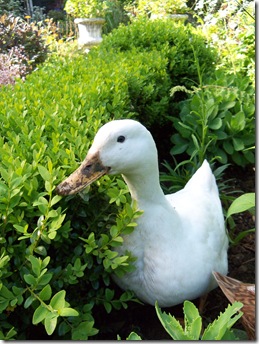 Sylvie, our one remaining Cherry Valley duck.
Was it anything to do with over hybridisation that pushed her body too far, she was underweight and had a tremendous appetite. Compared to the Khaki Campbell's, Cherry Valley duck eggs are considerably larger. Maybe they are a bit over hybridised and can push some individuals beyond what the body can sustain. Unfortunately as with all fowl, there is not much knowledge on this point; as stock they are pretty short lived. Individuals not shaping up are culled pretty quick.
Anyhow it's only a thought in this case about over hybridisation.
Over Hybridised Cattle
When it comes to cattle it definitely applies. Most people in Britain know of the proposed badger cull in Wales and the movement toward something similar in England. What many have no clue about is the weaknesses of the Holstein X Friesian breed of cattle. There is not a lot of information concerning this available to the public. Here though is some evidence showing up the over hybridisation in animals.
Holstein X Friesian have been bred as milking machines. So efficient are they at turning their food to milk, the animal itself in most cases become malnourished, not receiving enough food to maintain it's body systems to the degree it should.
Here is the interesting point that is never acknowledged. Tuberculosis is a disease of poverty; malnourishment is one of the prime causes of the contraction of TB, malnourishment of the body makes it less able to resist the disease.
Holstein X Friesian cattle are living lives of permanent malnourishment, irrespective of how much food they are given. They are extremely susceptible to many ailments and diseases, often with the average lifespan of only two years. It is little wonder that TB is rife amongst many herds of cattle.
Poor hybridisation can lead to weaknesses that cause disablement and suffering, but should be recognised for what it is. Unfortunately in the case of cattle the government departments are loath to admit this is one of the prime causes of herd breakdowns with TB, in fact they say there is no evidence to suggest this. Yet a study in Ireland points to the genetic weaknesses of the Holstein X Friesian breed. Another in Ethiopia is recommending farmers to return to the old Zebu breed of cattle who are so much less susceptible to bTB.
Pointing the finger at our badgers is lazy science, it is not getting to the real cause of the bTB in Britain, and one of the main causes is over hybridisation.


