This morning I came across what I thought was a casualty, laying in the heavy dewed grass the body of a Slowworm (Anguis fragilis).
 It's eyes were closed and it seemed fairly rigid when I picked it up. But I think the warmth from my hands made an immediate difference as a slight movement came from the wiry body. The tail was blunt at the end and looked as if it had lost it from an attack.
 The wound seemed to be fairly fresh. So it would seem that something had tried to make a meal of it and ended with just the end of the tail. In Slowworms this is their one defensive action they can take, to shed the end of the tail, allowing escape from the attacker.
I think in this case somehow it had got itself in the cold dewy grass and had chilled. So I held it for some minutes hoping the heat from my hands would help it become more lively.
The cold rigidity slowly gave way until it felt like a bronze bracelet that had life. I love the feeling of them in my hands, they seem to emanate such intense life in a small body.
I took it over to the place where it would be at it's safest, the compost heap.
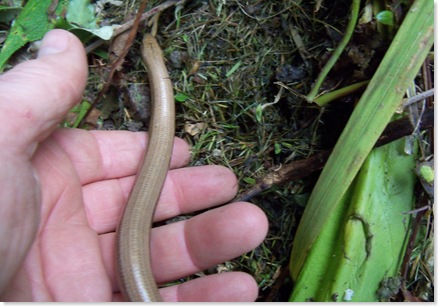 Quietly with a lovely grace to the movement it slid from my hand and pushed it's way into the heap and safety once more.
 There is some kind of fragile beauty to these small legless lizards that makes me feel great affection for them. They do no harm but much good, eating many of the dreaded small white slugs that do so much damage in the garden.
Their favourite place is within compost heaps, so whenever you break a heap open don't use a spade to slice down that they cannot escape from, use a fork as there is very little chance of spearing the body of a Slowworm.
There's more info on Slowworms here at Wikipedia


